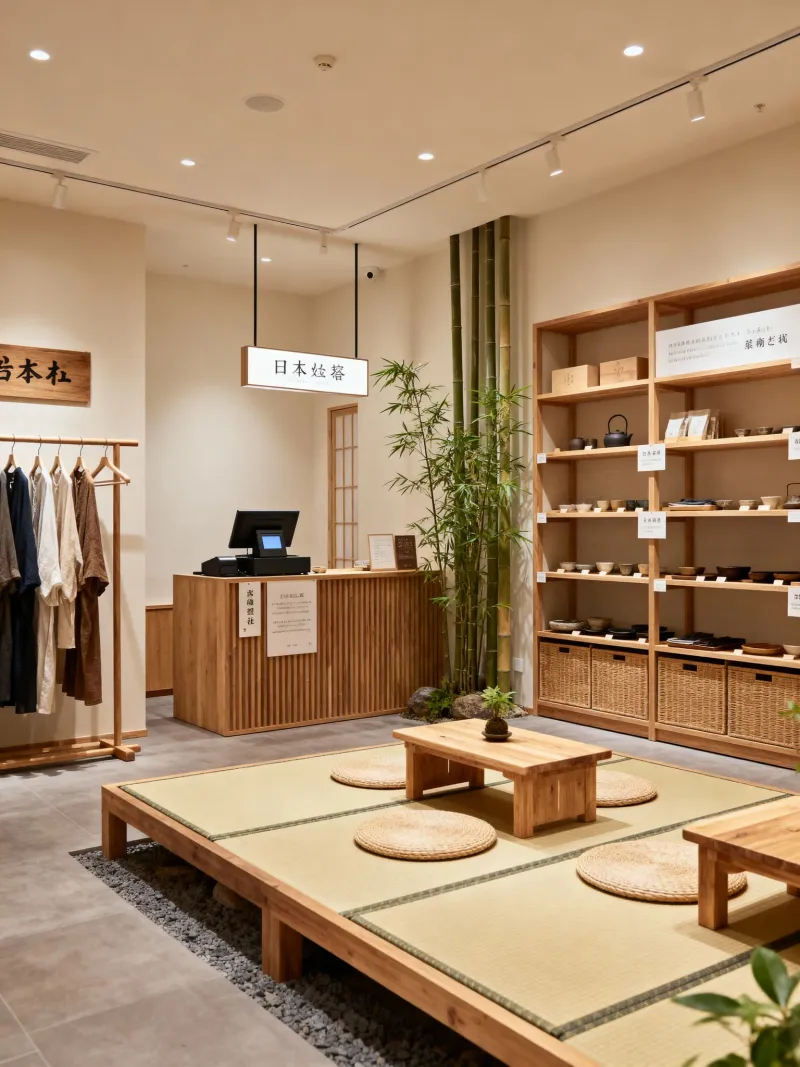
The Competency No One Teaches: Why the Ability to Be Still Is Now a Hiring Advantage in Luxury Home Retail

Photo: Ibrahim Achiri, CC BY-SA 4.0, via Wikimedia Commons
For decades, the archetype of the exceptional retail professional has been someone who speaks well under pressure — fluent in product features, confident with objections, quick to redirect a hesitant client. That archetype is being quietly renegotiated.
Across the premium home décor and interior lifestyle sector, hiring managers and creative directors are beginning to prioritize a different kind of skill — one that does not appear neatly on a résumé and cannot be rehearsed in front of a bathroom mirror. They are looking for professionals who know when not to speak, and what to do with the space that silence creates.
A Different Kind of Fluency
The Japanese concept of ma — often translated as purposeful negative space or meaningful pause — has long informed the visual grammar of Japanese design. In architecture and interior composition, ma refers not to emptiness but to potential: the charged quality of a space between objects, a breath between musical notes, a moment of stillness between exchanges.
What is now becoming apparent to forward-thinking retailers is that ma is not only a spatial philosophy. It is a communication philosophy. And in the context of luxury home design consultation, it may be one of the most commercially significant competencies a professional can develop.
When a client pauses while describing a room they want reimagined, that pause is rarely empty. It often contains the truest version of what they are trying to articulate — a feeling they have not yet found language for, a preference they are only beginning to recognize. The consultant who fills that pause prematurely, who rushes in with suggestions or redirects with a feature list, forecloses the possibility of hearing what the client actually needs.
The consultant who waits — who holds the silence with composure and genuine attention — earns something far more valuable than a transaction.
What Retailers Are Actually Measuring
The shift is showing up in how leading premium retailers structure their interview and evaluation processes. Role-play scenarios, once designed to test product knowledge and upselling technique, are increasingly being used to assess something subtler: how a candidate responds to ambiguity, how they behave when a client goes quiet, and whether they demonstrate curiosity before they demonstrate expertise.
Some organizations have introduced structured observation periods as part of their hiring pipeline, placing candidates on the floor not to sell but simply to interact — and then evaluating the quality of the questions they asked rather than the volume of information they delivered.
The findings, according to design retail professionals who have implemented these models, are consistent: candidates who listen with evident intention — who reflect back what they have heard, who ask follow-up questions that reveal genuine absorption of the client's words — tend to produce higher average transaction values, longer client relationships, and meaningfully better scores on post-visit satisfaction surveys.
This is not a soft finding. It is a business outcome.
The Silence Gap in American Retail Training
The challenge is that most retail training programs in the United States are not designed to cultivate this capacity. Sales training curricula tend to emphasize verbal technique: how to open a conversation, how to handle a price objection, how to close. These are not unimportant skills. But they address only one half of the communicative exchange, and arguably the less differentiated half.
In a luxury context — where clients are not simply purchasing an object but seeking a reflection of their values, their aesthetic identity, and their aspirations for how life at home might feel — the ability to hear beneath the surface of what is being said becomes the primary skill. Everything else is secondary.
Professionals who have developed this capacity often describe it as a practice rather than a talent. They speak of learning to become comfortable with pauses that would once have felt dangerous, of training themselves to resist the impulse to fill conversational space with noise. Many point to mindfulness disciplines, to time spent in environments that reward stillness — museums, traditional Japanese gardens, contemplative practices — as formative influences.
The professional implication is significant: active listening at this level is learnable. But it must be deliberately cultivated, and most conventional training environments do not provide the conditions for that cultivation.
What This Means for Career Development
For professionals building careers in premium home retail and design consultation, this shift creates a genuine competitive opening. In a field where product knowledge is increasingly commoditized — where a motivated client can research any item in a showroom before they arrive — the differentiating value of a skilled consultant lies in what they can surface, not what they can recite.
Developing a professional practice around active listening involves several concrete disciplines. The first is learning to formulate questions that invite reflection rather than demand information — questions that open rather than close. The second is developing comfort with the full beat of a client's response, resisting the urge to respond the moment they pause. The third is cultivating a vocabulary for reflection: the ability to paraphrase, reframe, and gently clarify what has been shared without imposing interpretation.
These are skills that translate directly into the language of Japanese hospitality philosophy — omotenashi, the practice of anticipating need before it is expressed — and they are finding new relevance in the premium American retail context precisely because they are rare.
A Hiring Landscape That Is Changing Its Criteria
For those entering the field or seeking to advance within it, understanding this shift is not merely interesting — it is strategically important. The organizations that are growing most deliberately in the Japanese-inspired home lifestyle category are not simply looking for design enthusiasts with pleasant demeanors. They are looking for professionals who can hold space, read a room, and build trust through the quality of their attention.
In interview settings, this means demonstrating listening as visibly as you demonstrate knowledge. It means asking thoughtful questions of your interviewer rather than simply answering theirs. It means showing, through the texture of your engagement, that you understand conversation as a collaborative construction rather than a performance.
The market for this kind of professional is expanding. The supply remains limited. That asymmetry is, for the right candidate, an opportunity worth taking seriously.